

McAllen’s #1 Rodent Problem
Roof Rat Removal McAllen, TX
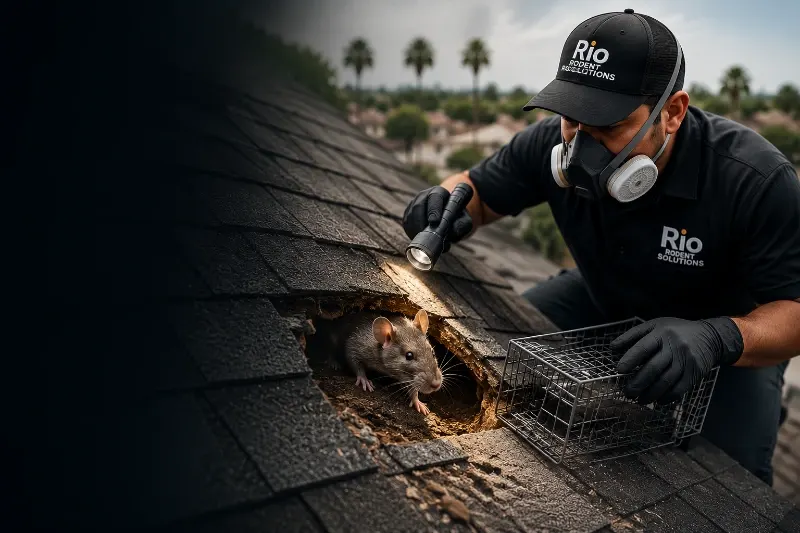
If you hear something running across the ceiling at night in McAllen, it is almost always a roof rat, sometimes called a tree rat. They nest in palm fronds, climb the trunk to your roofline, and move into your attic. We trap them, seal the way in, and cut off the route they used.
Why Here
The City of Palms Has a Roof Rat Problem
McAllen is nicknamed the City of Palms. That is charming right up until you understand what a roof rat is: an excellent climber that prefers to live above ground, nests in dense cover, and eats fruit, nuts and seeds.
A palm tree is, from a rat’s point of view, a furnished apartment. The crown of untrimmed fronds is dense, shaded, hidden from hawks and owls, and it sits at roof height. From there it is a short trip along a frond, a branch or a power line onto your roof, and then in through a gap you have never looked at.
Add the Valley’s citrus. A grapefruit, orange or lemon tree in the backyard is a nightly food source. The pattern we find in McAllen again and again: rats feed in the yard at night and sleep in the attic by day. That runs year-round, because our winters never get cold enough to break the cycle.
This is why a rat problem in McAllen says nothing about how clean your house is. Homes in Tres Lagos and North Ridge get roof rats for the same reason the older houses off Pecan Blvd do: the trees, the fruit, and the warm weather.
Identification
Is It a Roof Rat? How to Tell
The Animal
Slim and dark, 12 to 16 inches counting the tail, and the tail is longer than the body. Large ears, pointed nose, big eyes. This is the rat most people in Texas mean when they say “tree rat” — same animal, different name. A Norway rat is heavier, browner, blunt-nosed, with a tail shorter than its body.
Where You Hear Them
Above you. Ceiling, attic, upper walls, soffits, usually after dark, because they are nocturnal. Norway rats and mice stay lower: kitchen walls, cabinets, garage, crawl spaces.
The Droppings
Roof rat droppings are about half an inch, dark, curved and pointed at the ends, bigger than a mouse’s quarter-inch grains. Fresh ones are soft and shiny. Dry, crumbly ones are old.
The other signs we look for
- Grease marks. Dark smudges along rafters and the tops of walls, left by oily fur on a route they run every night.
- Gnaw marks on wire and wood. Rat incisors never stop growing, so they never stop chewing. Stripped wiring in an attic is a real fire risk.
- Hollowed fruit in the yard. A grapefruit or orange eaten out and left on the branch is a roof rat calling card.
- Shredded insulation or palm fiber pushed into a corner of the attic. That is a nest.
- Seeing one in daylight. Roof rats are nocturnal. A daytime sighting usually means the population is large enough that they are competing for food and space.
Our Method
How We Get Roof Rats Out of Your Attic
01 Attic & Roofline Inspection
We go into the attic and onto the roof. We map active runways, nests, droppings and every gap: soffit returns, roof-to-wall joins, vents, the AC line set, weep holes, and where palms and branches touch the house.
02 Targeted Trapping
Snap traps set directly on the runways we found, along beams and wall tops, not scattered on the attic floor. Roof rats follow the same routes nightly. Placement is the whole game.
03 Sealing the Roofline
Every entry point gets closed with material a rat cannot chew: steel wool, copper mesh, hardware cloth, metal flashing, concrete. A roof rat only needs a gap the size of a quarter. Miss one and the job is not finished.
04 Cutting the Highway
Sealing the house is half of it. We tell you which palm fronds and branches to cut back from the roof, what to do about fallen citrus, and where the bird feeder and the dog food bowl are working against you.
05 Cleanup & Follow-Up
We remove nests and droppings, sanitize, and advise on insulation if it is contaminated. Then we return, check traps and confirm the attic has gone quiet. Most roof rat jobs resolve in 2 to 4 weeks.
Straight Talk
Please Do Not Just Throw Poison in the Attic
It is the most common thing McAllen homeowners try, and in our climate it backfires badly. A poisoned roof rat does not politely leave. It crawls into a wall cavity or under the insulation and dies there. In a South Texas attic well over 100 degrees, decomposition is fast and the smell is severe, and it can last for weeks.
There is a second cost. A rat full of anticoagulant bait that gets eaten by a dog, a cat, or by one of the hawks and owls this region is known for can poison that animal too. The Valley is a birding destination for a reason.
We use bait where it belongs: exterior stations, and some commercial and agricultural sites. But for a McAllen house with rats in the attic, trapping plus sealing wins every time. See our McAllen rodent control cost guide for what a real roof rat job runs.
Questions
Roof Rats in McAllen: FAQs
Why are there rats in my palm trees in McAllen?
Roof rats are climbers that nest in the dense crown of untrimmed palm fronds. The fronds give them cover from hawks and owls, and the tree puts them at roof height. From the palm they cross onto the roofline and into the attic through any gap the size of a quarter. In the City of Palms this is the most common way rats get into a home.
What is the difference between a roof rat and a Norway rat?
A roof rat is slim and dark, 12 to 16 inches including a tail that is longer than its body, and it lives high up in attics, rooflines and trees. A Norway rat is heavier and browner with a blunt nose and a tail shorter than its body, and it lives low in burrows, foundations and crawl spaces. In McAllen homes, roof rats are far more common.
How do roof rats get into an attic?
Through gaps at the roofline: soffit returns, roof-to-wall joints, vents, weep holes, and the opening where the air conditioner line set enters the wall. A roof rat can squeeze through a hole the size of a quarter. They reach the roof by climbing palm trunks, tree branches, fences or power lines.
Do roof rats go away on their own in winter?
No. McAllen winters are mild, with January lows around 53 degrees, so there is no cold snap to kill off or drive out the population. Roof rats breed year-round here. A small problem in February will be a bigger problem by summer if it is left alone.
How long does it take to get rid of roof rats?
Most roof rat jobs in McAllen resolve in two to four weeks. That covers the inspection, active trapping, sealing every entry point, and follow-up visits to confirm the attic has gone quiet. Heavier infestations take longer.
Will trimming my palm trees get rid of the rats?
Trimming helps a great deal but it is not a cure on its own. Cutting fronds and branches back from the roof removes the highway they use to reach the house. But rats already in the attic still have to be trapped, and the entry points still have to be sealed, or new rats will find their way back in.
Are roof rats dangerous?
They carry real risks. Rodent urine and droppings can spread salmonella, leptospirosis and hantavirus, and dried droppings can become airborne dust in an attic. Roof rats also gnaw constantly, and chewed electrical wiring in an attic is a genuine fire hazard.
Roof rats causing problems at a commercial property rather than a house? See our commercial rodent control page for how we handle drop-ceiling voids, dumpster corrals, and other business-specific entry points.
Go Deeper
More on Roof Rat Removal
- What’s Included in Roof Rat Removal in McAllen — a step-by-step look at the full process.
- Signs You Need Professional Roof Rat Removal — how to tell DIY has run its course.
- Cost of Roof Rat Removal in McAllen — what drives pricing and how to compare quotes.
Schedule a McAllen Rodent Inspection
We will tell you what you are dealing with, how they are getting in, and exactly what it will cost to fix. No pressure, no guessing.
Rio Rodent Solutions · McAllen, TX · (956) 660-9706 · Licensed & Insured, TDA License [TPCL#] · Se Habla Español