

The Step That Actually Ends It
Rodent Exclusion & Rodent-Proofing McAllen, TX
Trapping removes the rats and mice that are already inside. Exclusion is what stops the next ones from walking in the same hole. It is the difference between a pest problem that ends and one you pay for again every year.
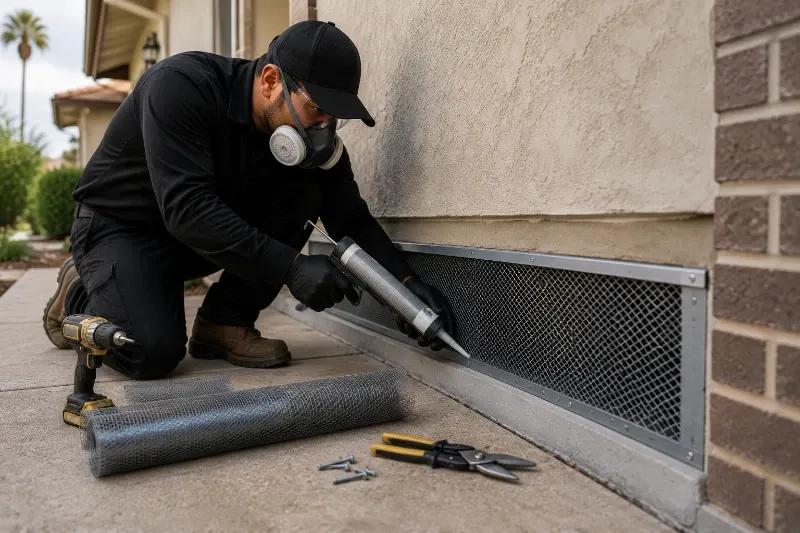
The Core Idea
Trapping Without Sealing Is Just Renting Time
Here is the uncomfortable truth about most rodent jobs in the Valley. A company comes out, sets traps or throws down bait, catches a few rats, and leaves. For a few weeks the house is quiet. Then the scratching comes back, and you assume you have bad luck.
You do not have bad luck. You have an open hole. The rats that were removed have simply been replaced by the next ones, because nothing about the house changed. In McAllen, where the population never gets knocked back by winter, that replacement happens fast.
A rat needs a gap the size of a quarter. A mouse needs a dime. Until those gaps are closed with material they cannot chew, every other step is temporary, and every day it stays open is a day of continued exposure to the droppings and urine behind several rodent-borne diseases.
If this sounds like your situation after paying someone else already, read why treatment from another company often does not hold and what a second-opinion inspection actually looks like.
Where We Look
The Entry Points We Find on McAllen Homes
Older homes across central and south McAllen (78501, 78503) tend to have the most. But new builds in north McAllen (78504) have them too, usually where a trade cut a hole and nobody sealed it. The gap that matters most depends on which species you have; see our rodent species identification guide if you are not sure yet.
Up High (Roof Rats)
Soffit returns, roof-to-wall joins, ridge and turbine vents, fascia gaps, and the corners where two roof planes meet. This is where roof rats coming off a palm get in.
Down Low (Mice & Norway Rats)
Weep holes, cracked mortar, the gap under a heat-warped garage door seal, and the door between the garage and the kitchen.
The Utility Gaps
The AC line set is the number one offender in the Valley. Plus plumbing penetrations, dryer vents, electrical conduit and cable entries.
Materials
What We Seal With, and What Does Not Work
Rodent incisors never stop growing, so rodents never stop gnawing. The material has to beat the tooth.
✓ What Holds
Steel wool and copper mesh packed into gaps. Hardware cloth over vents. Galvanized metal flashing on chewed fascia and soffit edges. Mortar or concrete on masonry. Sheet metal kick plates at door bases.
✕ What Fails
Expanding foam on its own, which a rat chews through in a night. Caulk alone. Plastic vent covers. Duct tape. Cardboard and plywood patches. Anything soft is a suggestion, not a seal.
Foam has a place, as a backer or a sealant behind mesh. It just cannot be the thing standing between a rat and your attic.
Also Worth Doing
Rodent-Proofing Before You Have a Problem
Exclusion is not only for people who already hear scratching. Two situations in McAllen make it worth doing preventively.
- There is demolition or construction on your street. When a nearby house is torn down or a lot is cleared, the rats living in that foundation do not vanish. They relocate to the nearest occupied structure. Sealing your home before they arrive is far cheaper than trapping them after.
- You are a Winter Texan coming back to a unit that sat empty. A mobile home or RV that stood closed through a Valley summer is exactly what rodents look for. Skirting gaps, vents and utility penetrations are the usual way in.
Exclusion cost in McAllen varies based on the job, driven by the number of entry points and how much roof work is involved. See the cost guide for the full breakdown, or read about roof rats if the noise is above your ceiling.
Questions
Rodent Exclusion in McAllen: FAQs
What is rodent exclusion?
Rodent exclusion is the process of finding and permanently sealing every gap a rat or mouse can use to get into a building, using materials they cannot chew through, such as steel wool, copper mesh, hardware cloth, metal flashing and concrete. Trapping removes the rodents already inside; exclusion is what keeps the next ones out.
How much does rodent-proofing cost in McAllen?
Exclusion work cost varies for a McAllen home. The price depends mostly on how many entry points there are and whether roof and ladder work is needed. Older homes in 78501 and 78503 often have more gaps than newer builds, which raises the cost.
Why is sealing more important than trapping?
Because trapping alone does not change anything about the house. The rodents removed simply get replaced by new ones coming through the same opening, and in McAllen the population never gets thinned out by winter, so replacement is fast. Sealing is the only step that ends the cycle rather than pausing it.
Can I just use expanding foam to seal the gaps?
No. A rat will chew straight through expanding foam, often in a single night, and the same goes for caulk, plastic and duct tape on their own. Foam is useful as a backer or sealant behind a hard barrier, but the barrier itself has to be steel wool, copper mesh, hardware cloth, flashing or concrete.
What size gap do I actually need to seal?
A roof rat can pass through a hole the size of a quarter, and a house mouse through one the size of a dime. A practical rule of thumb is that if a pencil fits through a gap, a mouse can get through it, so gaps that look far too small to matter usually do matter.
My neighbor is demolishing their house. Should I rodent-proof now?
Yes, that is a good reason to act early. When a nearby home is torn down or a lot is cleared, the rodents living there relocate to the closest occupied building. Sealing your home before they arrive costs much less than trapping an established infestation afterward and repairing the damage.
Do you guarantee the exclusion work?
Yes. Sealing is the part of the job we stand behind, because it is the part that determines whether the problem stays fixed. We will walk you through the entry points we found and what each one was sealed with.
Do you provide rodent exclusion and proofing in Edinburg?
Yes. Edinburg shares the same core problem as McAllen — a lot of homes built before 2000, mature palm and citrus trees, and winters mild enough that rodents never really stop breeding. Rodent exclusion and proofing work in Edinburg is the same process we use in McAllen: find every gap around the roofline, pipes and vents, and seal it, not just set traps and leave.
Go Deeper
More on Rodent Exclusion
- What’s Included in Rodent Exclusion in McAllen — a step-by-step look at the full process.
- Signs Your McAllen Home Needs Rodent Exclusion — how to tell traps alone are not enough.
- Cost of Rodent Exclusion in McAllen — what drives pricing and how to compare quotes.
Schedule a McAllen Rodent Inspection
We will tell you what you are dealing with, how they are getting in, and exactly what it will cost to fix. No pressure, no guessing.
Rio Rodent Solutions · McAllen, TX · (956) 660-9706 · Licensed & Insured, TDA License [TPCL#] · Se Habla Español